
Glossary · the words of growing for chefs
From microgreens to succession planting.
The words growers who supply kitchens use every week — in the garden, in the grow room and at the kitchen door — each answered in a sentence first, with a link to the page that shows it.
One tray, seed to the pass
Seven words, one tray.
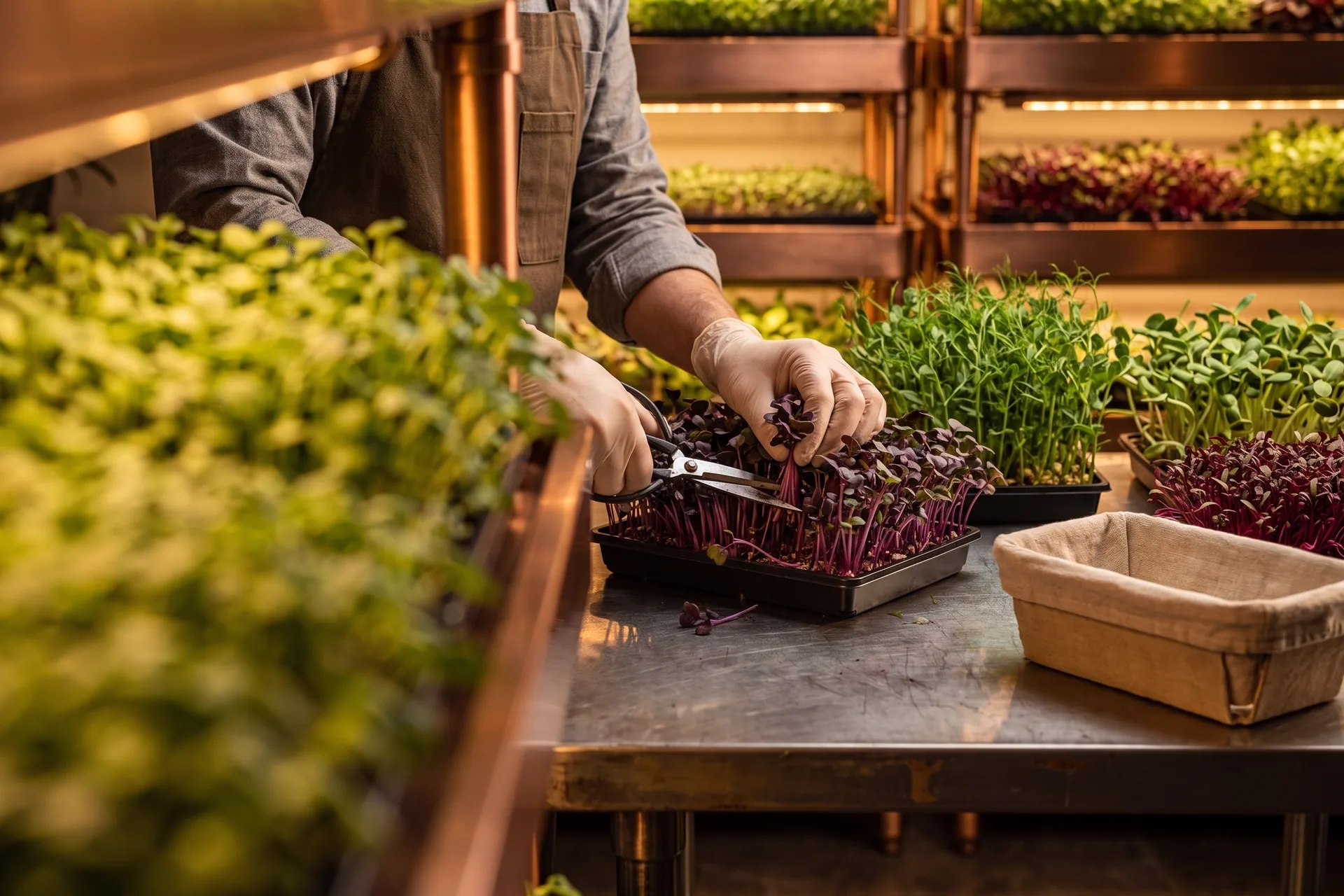
Follow a tray of purple radish microgreens along the bench, from the seed to the kitchen. Each step lights its word; the words link to their definitions below.
- 1SoakSeed soaked, if the variety wants it
- 2SowSpread on the growing medium in a tray
- 3BlackoutCovered and weighted in the dark
- 4LightUncovered under the grow lights
- 5CutCut above the root
- 6PackInto a punnet for the order
- 7The passHanded across to the kitchen
57 terms
No term matches. Try a shorter word.
Selling to a kitchen
How growers and chefs work together, from the first sample to the delivery.
11 terms- Farm to table
A way of running a kitchen around produce bought straight from the people who grow it, often named on the menu. For a grower it means chefs who want to know where and when something was grown.
Also called Farm to fork
- Hyper-local
Produce grown very close to where it is eaten — on the restaurant’s own roof, in its courtyard, or a few streets away.
- Approved source
A supplier a food business is allowed to buy from under its local food rules. Kitchens may ask a grower to show they qualify; the rules differ by country and region, so check with the local authority.
- Chef request
What a kitchen asks a grower for beyond the usual order: a crop, by a date, in an amount — “purple radish from the Friday after next”.
In Ortalio a chef request is logged with what, by when and how much, and linked to the crop-plan line that answers it.
- Availability list
The short list a grower sends the chef, usually each week, of what is ready and roughly how much, so the chef can order from it.
Also called Fresh sheet
- Standing order
A regular order a kitchen keeps with a grower — the same crops, amounts and days each week until it changes. In the UK, Ireland, Australia and New Zealand the words also mean a regular bank payment, so growers there say a standing weekly order or a recurring order.
In Ortalio a standing weekly order is recurring delivery work: each delivery is logged against it, and it is invoiced per delivery or once a month.
Also called Standing weekly order · recurring order
- Pick list
The list of what to harvest on a given day, worked out from the orders due.
- Packing list
What goes into each kitchen’s crates for a delivery, line by line, checked as it is packed.
- Short and substitution
A short is a line delivered in a smaller amount than ordered, or not at all; a substitution is something else sent in its place, agreed with the chef.
In Ortalio a short is logged on the delivery itself, so the invoice and the record match.
- Delivery window
The time a kitchen can receive a delivery, usually outside service. Each kitchen has its own.
Also called Receiving window
- Kitchen pass
The counter between the kitchen and the dining room where finished plates are handed over — and where a grower’s crate often lands.
Also called The pass
On the client’s site
The gardens growers keep for restaurants and hotels, and how Ortalio files them.
10 terms- Edible landscaping
Designing and keeping planting that is meant to be eaten — herbs, vegetables, fruit and edible flowers — as part of a property’s gardens.
- Kitchen garden
A garden grown to supply a kitchen, usually close to it: beds of herbs, salad leaves and vegetables picked as the menu needs them.
Also called Potager
- Chef’s garden
A kitchen garden planted to one chef’s menu, often with varieties the kitchen can’t buy.
- Rooftop garden
Beds, containers or growing stations on a building’s roof. On a hotel or restaurant it is often grown for the kitchen and the bar, and shown to guests.
- Edible wall
A vertical planting of herbs or leaves a kitchen harvests from. A purely ornamental living wall is a different trade.
- Raised bed
A bed built up above the ground in a frame, filled with soil — the usual growing station on a roof or courtyard.
- Site
A place where you grow for a client: the client’s property, or your own farm.
In Ortalio a site is either the client’s property or your own farm; both work the same way.
- Growing station
One place a crop grows on a site: a bed, a hydroponic tower, a microgreen rack, a channel or a greenhouse bed.
In Ortalio each growing station has its own ID and history, on the client’s site or your own farm.
- Garden visit
A grower’s scheduled visit to a client’s garden to sow, care for, read and harvest.
In Ortalio a program’s garden visits repeat on the Growing Calendar on the rhythm you set.
- Program
An ongoing agreement to grow for a client, with visits on a rhythm and a crop plan that runs season after season — not one-off visits.
In Ortalio a program is a recurring series, billed monthly or per visit.
Planning the crop
The words of a crop plan: when to sow, when to cut, and what can go wrong between.
12 terms- Crop planning
Deciding what to grow, where and when, so the right crops are ready when the kitchen needs them.
- Crop plan
The written result of crop planning: crops, stations, sowing and harvest dates, and the successions between them.
In Ortalio the crop plan holds each station’s successions, with the next sowing planned before the last harvest.
- Succession planting
Sowing the same crop again at intervals, so the next planting is ready as the last one finishes and the kitchen never runs short.
In Ortalio the crop plan holds each station’s successions, with the next sowing planned before the last harvest.
Also called Successive sowing
- Crop rotation
Moving crop families to a different bed each season to keep soil healthy. Not the same thing as succession planting, which repeats one crop over time.
- Days to maturity
How long a variety usually takes from sowing or transplanting to its first harvest, as the seed supplier gives it. Real timing depends on the season and the site, so growers keep their own.
- Harvest window
The stretch of days a crop is at its best to cut.
- Direct sowing
Sowing seed straight into the bed where it will grow.
- Transplant
A young plant raised in a tray or pot and moved into its bed; also the act of moving it.
- Hardening off
Getting young plants raised indoors used to outdoor conditions a little at a time before transplanting.
- Bolting
When a leafy crop runs to flower early, often in heat, and turns bitter — the moment a succession has to be cut short.
- Cut-and-come-again
Crops cut a few leaves at a time so they regrow for several harvests.
- Edible flowers
Flowers grown to be eaten or used to garnish — nasturtium, borage and many more — usually picked on the day.
Microgreens and indoor growing
Trays, racks, lights and water: growing without a garden.
13 terms- Microgreens
Young greens grown in light, in soil or on a mat, and cut above the root once their first leaves open.
- Sprouts
Germinated seeds eaten whole, root and all, grown in water without light — a different product from microgreens.
- Tray
The shallow tray microgreens grow in, one crop to a tray.
Also called Flat
- Growing medium
What seeds grow in instead of garden soil: a soil mix, coir or a fibre mat.
- Soak
Soaking larger seeds, such as peas and sunflowers, in water before sowing so they start evenly.
- Blackout period
The days a sown tray spends covered, often weighted, in the dark, so the shoots stretch before they see light. Growers set it per crop.
- Grow light
The light that indoor trays and stations grow under.
- Microgreen rack
Shelving that holds trays in tiers, usually with a grow light over each shelf.
- Live tray
A tray delivered still growing, for the kitchen to cut as it goes.
- Clamshell / punnet
The small lidded box or basket microgreens and leaves are packed in for a kitchen.
Also called Punnet
- Hydroponics
Growing plants without soil, their roots fed by water with nutrients dissolved in it.
- NFT (nutrient film technique)
A hydroponic system where a thin film of nutrient solution flows along a channel past the roots.
- Hydroponic tower
A vertical hydroponic system with plants in pockets up its sides, fed from a reservoir at its base.
Readings
The two readings Ortalio is built to keep on hydroponic stations.
5 terms- EC (electrical conductivity)
How strongly a nutrient solution conducts electricity, which shows how much nutrient is dissolved in it. Read with a meter and written in mS/cm.
In Ortalio EC and pH are logged on hydroponic stations and shown against the target range you set.
- pH
How acid or alkaline a nutrient solution is. In hydroponics it affects which nutrients the roots can take up.
In Ortalio EC and pH are logged on hydroponic stations and shown against the target range you set.
- Target range
The band a grower wants a reading to stay inside, set for each station and crop by the grower.
In Ortalio the target range is yours to set per station; Ortalio never sets one for you.
- Nutrient solution
The water and dissolved nutrients a hydroponic system feeds its plants.
- Reading
One measurement taken on a station on a given day, such as EC or pH.
Records and reports
What the work leaves behind, and what the chef can read.
6 terms- Harvest record
What was cut, from which station, how much and when.
In Ortalio a harvest is logged at the station it came from.
- Delivery record
What went to which kitchen, how much, when, and anything short — checked against the order.
In Ortalio a delivery is logged at the kitchen door against the order, with a photo if you want one.
- Finding
Something a grower notices and notes: a pest, a crop running to flower, a reading outside its range.
In Ortalio each finding is marked routine, attention needed or issue, with what you did about it.
- Growing Calendar
Ortalio’s calendar of sowings, successions, garden visits and delivery days.
- Garden & Harvest Report
Ortalio’s report for a client: the visits or deliveries, plantings, readings, harvests and requests answered over a period.
In Ortalio it goes out in your company’s name when the chef asks, when you choose, or on a timetable you set.
- Work Record
The record of one finished job: its steps and times, photos before and after, materials and the grower’s note.
In Ortalio every finished job keeps one; the client sees it if they ask for it, or if you decide to share it.
Ortalio keeps the record of what you planned, read, cut and delivered. It does not certify food safety, trace produce for a regulator or forecast yields: the record is yours, and the kitchen reads what you choose to send.
Keep going
See the words at work.
- Successions, planned aheadA chef’s request turned into a succession on the crop plan, before the last harvest.See the plan
- Trays on a short cycleA rack sown to each week’s orders, for many small kitchens.See the trays
- Questions growers askSelling to chefs, standing weekly orders, and what Ortalio never claims.Read the answers
Founding access
Put the words to work.
Founding access is open to the growers who supply restaurants and hotels. Claim it and you’ll hear first when Ortalio opens.
Launching with a 14-day free trial. No card needed.