
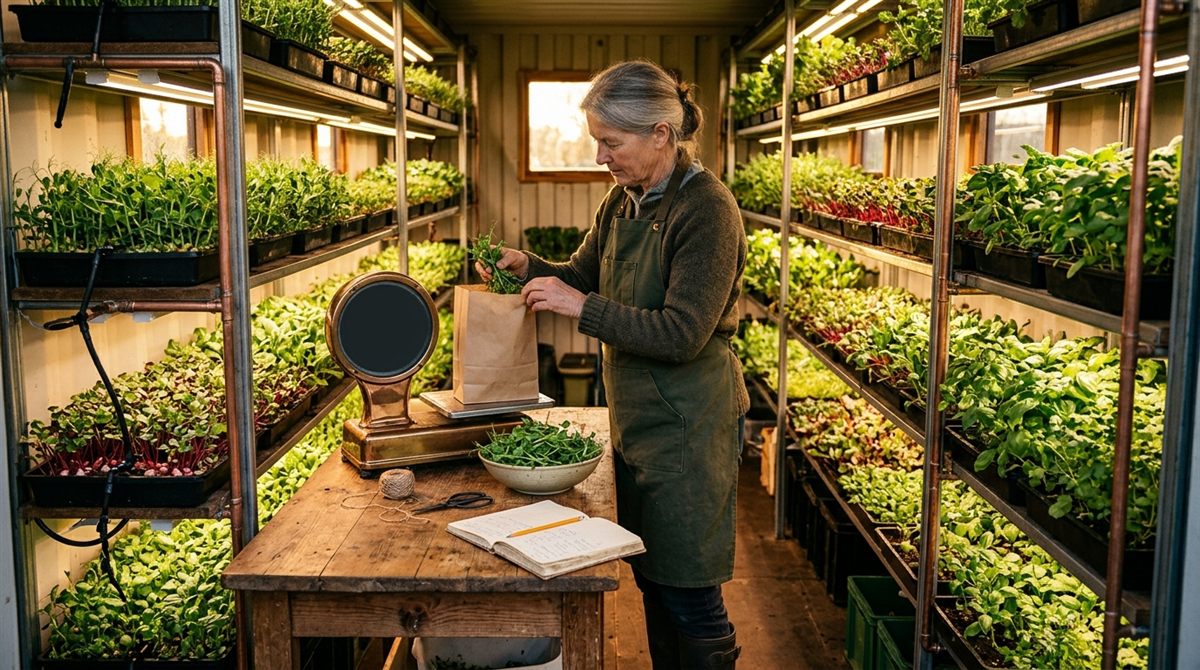

He had started the year sure of one thing: $4 an ounce, for everything, to everyone. Pea shoots, radish and a house mix went into one-ounce clamshells on a folding table at the Saturday market, and the table was empty by noon. It hadn’t crossed his mind that pricing microgreens for restaurants might be a different sum. He had no restaurants yet.
Dan grows all three in a shipping container behind a friend’s warehouse, on four shelves of trays under lights. Dan is not a real person. He, his chef and his week are an example built for this guide.
Pricing microgreens for the Saturday market
By September the stall was busier than it had ever been, and Dan’s bank balance had hardly moved since spring. He blamed start-up costs. Then he sat down with the tray budget that one state university’s extension service publishes for microgreens growers. In this example Dan grows in the United States, and his costs are the ones that budget gives; a grower anywhere else would put their own costs into the same lines.
The budget’s setup was close to his: standard 10-by-20 trays on a steel shelf, under lights, sold at $4 an ounce. It counts every line of a tray’s cost, down to a share of the shelf. It also charges for the grower’s own time: 15 minutes a tray, at $20 an hour. Dan had been paying himself nothing.
Run through that budget, his three crops stopped looking alike. A tray of the mix yields 11.5 ounces and clears $14.20 after every cost. Pea shoots and radish yield 8 ounces a tray. Pea shoots clear $6.58 and radish $5.84. He was charging the same price per ounce, and a tray of either light crop earned less than half as much. The heavy trays had been carrying the others, and a busy stall had hidden it.
Then he looked at where a pea tray’s $25.42 went. Eight labels, eight clamshells and the budget’s allowance for marketing came to $12.96. Half the cost of the tray was the cost of selling it an ounce at a time.
Finding the first kitchen
The stall couldn’t grow, because a week has one Saturday. Restaurants cook on the other six days. Dan had never sold to one. He assumed chefs already had suppliers and didn’t want a call from a stranger with a cooler.
A growers’ guide from 1995 says the opposite. Chefs told its author they welcome calls from growers and rarely get them. So the guide tells growers to make the first move. Make a list of the restaurants within one delivery run. Call ahead, and ask for the chef between two and four in the afternoon, when the kitchen is quiet. Take samples, let them taste, and leave a sheet that says what you grow and what it costs.
He listed eleven restaurants within twenty minutes of the container. Four never called back. Three said no. Three kept his samples and told him to try again in spring.
The eleventh was a bistro. On a Tuesday in October, at half past two, its chef tasted the pea shoots at the pass and asked for two pounds a week. Then he said what his distributor charged him: $2.50 an ounce. Could Dan match it?
Pricing microgreens for restaurants, one tray at a time
At first he thought he couldn’t. A tray of pea shoots cost him $3.18 an ounce before any profit, and the chef was offering $2.50. He asked for two days.
That night he saw what he had missed. The chef wasn’t buying clamshells. A kitchen takes a whole tray of pea shoots in one 8-ounce bag with one label, and nobody stands at a stall to sell it. So he costed the same tray a second time, the way a kitchen would buy it.
| Cost line | Market tray: eight 1-oz clamshells ($) | Kitchen tray: one 8-oz bag ($) |
|---|---|---|
| Seed | 0.38 | 0.38 |
| Growing media | 3.00 | 3.00 |
| Fertilizer | 0.07 | 0.07 |
| Electricity | 1.20 | 1.20 |
| Labor, 15 minutes at $20 an hour | 5.00 | 5.00 |
| Labels | 4.80 | 0.60 |
| Packages | 3.36 | 0.42 |
| Marketing, 15% of sales | 4.80 | — |
| Delivery run, share per tray | — | 2.00 |
| Repairs and operating interest | 1.33 | 1.33 |
| Equipment, depreciation and interest | 1.48 | 1.48 |
| Total per tray | 25.42 | 15.48 |
| Cost per ounce, 8 oz per tray | 3.18 | 1.94 |
| Cost per ounce sold, one tray in ten unsold (÷ 0.9) | — | 2.16 |
| Floor price, a fifth kept (÷ 0.8) | — | 2.70 |
His floor was $2.70 an ounce: enough to cover the one tray in ten that fails or that the kitchen orders short, and still keep a fifth of the price after every cost, his own hours included.
At $2.50 he would clear 34 cents an ounce, about $11 a week, and one bad week would wipe out a month. Matching the distributor wasn’t a price. It was a favor.
What he told the chef
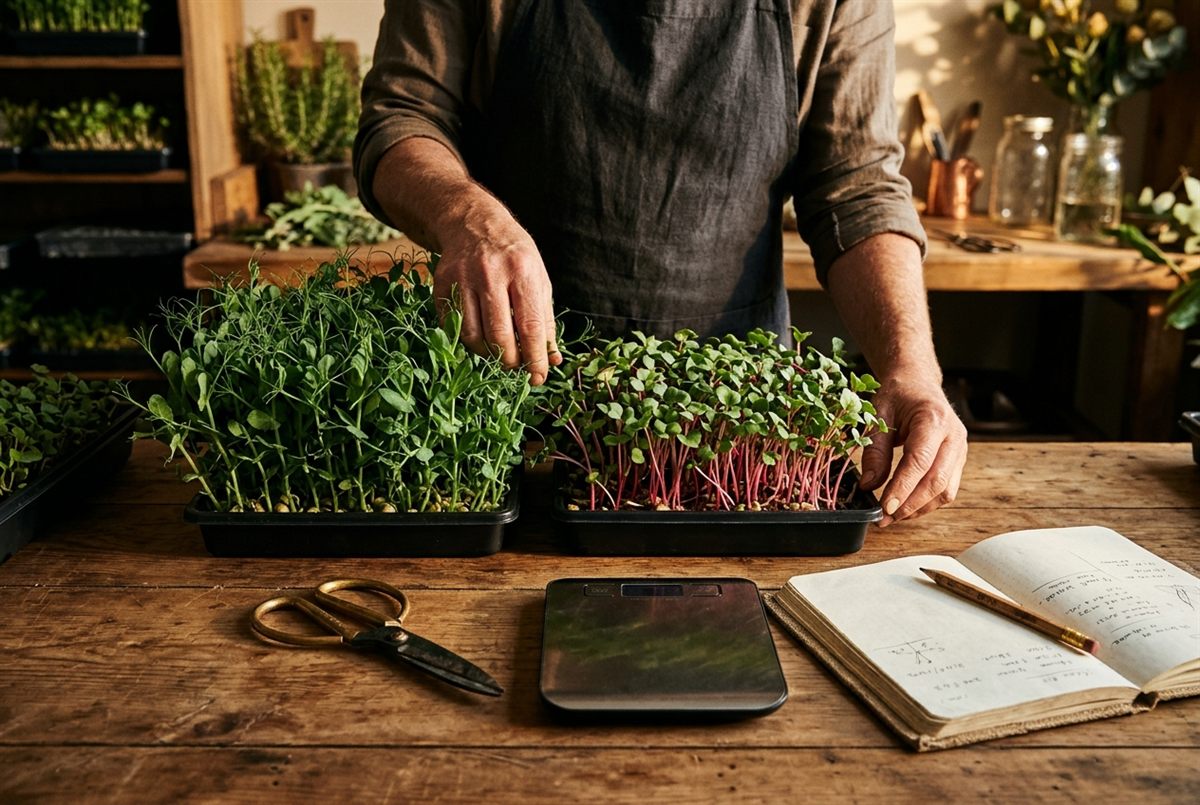
He still didn’t know how far above the distributor a kitchen would go, so he went looking. A 2015 guide from another state university gave him the top. Chefs are used to wholesale prices, it says, but many pay more for local produce when they can see the benefit: in surveys of restaurants in two states, most chefs in some areas said they would pay up to 30% more, mainly because fresher produce meant less waste.
The 1995 guide gave him the bottom, 10% over wholesale for everyday items. Neither guide is new, so he took them as a range. On the chef’s $2.50, that range ran from $2.75 to $3.25. His floor sat just under it.
He called on Thursday. The offer was $2.75 an ounce, cut on Wednesday afternoon, delivered on Thursday morning and held until April. It wasn’t $2.50, he said, because the price had to cover the tray, the drive and his own hours.
The chef pushed back. His distributor never asked him to commit to a price. Dan said his distributor didn’t cut on a Wednesday afternoon either. Then he asked how the bistro paid. The 1995 guide is blunt that some restaurants pay late, and says to settle it before the first delivery. The bistro’s terms were fourteen days.
In the end the chef took the two pounds. He passed on radish at Dan’s price, though, and Dan didn’t chase it.
Four trays every Thursday
Two pounds a week is four trays. At $2.75 they bring Dan about $19 a week above his costs, after allowing for the tray in ten that fails. In a week when nothing fails, they clear $26. That is what the same four trays clear on a Saturday, but only when every clamshell sells. So the kitchen pays about what the stall does. It also takes one delivery and no clamshells, and it orders when it rains.
The bigger change was the list. In the spring he went back to the three chefs who had kept his samples. This time he brought a sheet with a kitchen price for each crop, worked out the same way. One of them now takes pea shoots and the house mix every week. Radish still sells best at the stall, at $4, so that’s where it goes.
The bistro’s Thursday order was still on Dan’s sheet: two pounds of pea shoots, and no radish.
The short answer: Pricing microgreens for a restaurant starts with one tray, costed the way the kitchen buys it, as one bag that you deliver. Divide that tray’s cost by the ounces it yields, allow for the one tray in ten that fails or goes unsold, and add enough to keep a fifth of the price for yourself: that is your floor. Quote above that floor rather than at the distributor’s price. This week, work out your own floor with the table above, then ask the chef how the kitchen pays.
BEFORE YOU MATCH A PRICE
Pricing microgreens for a kitchen works when the tray is costed for the kitchen.
Dan’s floor came from his own trays, not from the chef’s distributor. Ortalio was built to keep crop plans, harvests and deliveries on one record, so each tray’s numbers come from your own weeks.
Sources and references
- University of Missouri Extension (M. Ale and J. Cabrera-Garcia), “Microgreens Planning Budget”, G693, May 2024, revised July 2024. extension.missouri.edu
- E. Gibson, “Selling to Restaurants”, in Direct Marketing Alternatives, 1995, University of Arizona Cooperative Extension. extension.arizona.edu (PDF)
- NC State University (M. D. Ernst), “Selling to Restaurants in North Carolina”, 2015. rvs.umn.edu (PDF)